Are you looking for Paving Permits and Regulations in Pennsylvania for a new driveway, sidewalk, parking lot, or pavement replacement project? Before work starts, it is important to understand which permits may be required and which rules apply to the project. Whether you are a homeowner replacing a residential driveway or a business improving a commercial parking area, paving work often involves more than just selecting asphalt or concrete. In many cases, you also need to account for municipal building or zoning approvals, right-of-way permits, stormwater considerations, and accessibility standards.
For property owners in and around Pittsburgh, the process can involve several layers. Pennsylvania uses the Uniform Construction Code, but permit administration is handled locally, which means city, borough, township, and county requirements can differ depending on where the project is located. If the work affects a state road, PennDOT may also need to approve it through a Highway Occupancy Permit. In the City of Pittsburgh, curb cuts and work in the public right-of-way are reviewed through DOMI, while county-owned roads in Allegheny County have their own permit process.
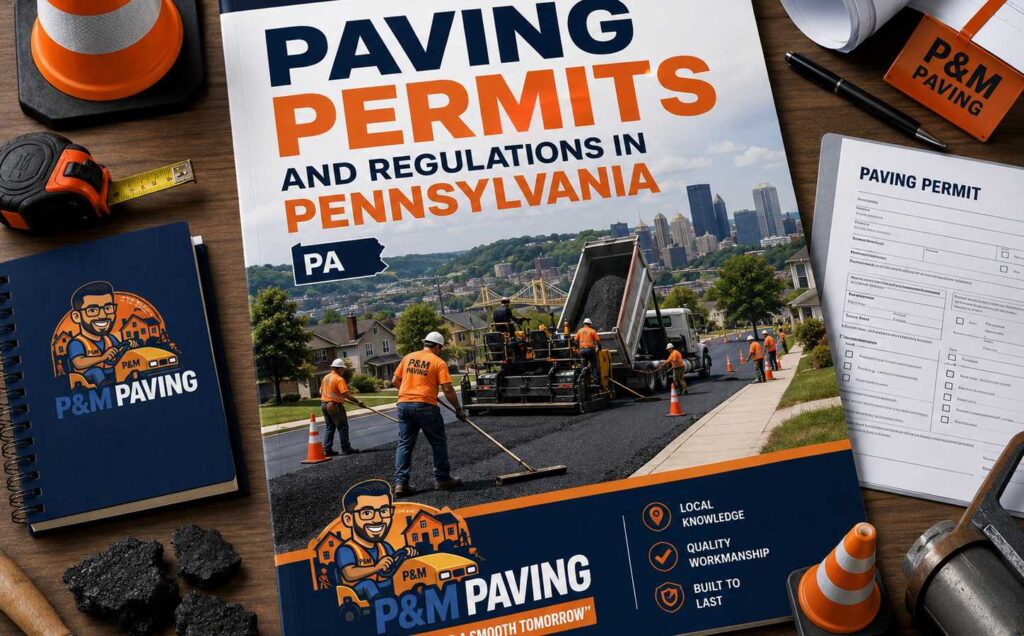
This guide explains the main permit and regulatory issues for paving work in Pennsylvania, with a strong focus on the Pittsburgh market. It is meant to help homeowners, property managers, and commercial owners understand what to expect before starting a project.
Why paving permits and regulations matter
Permits are not just paperwork. They help make sure the work is safe, legal, and built to the proper standard. In Pennsylvania, local governments use permits and inspections to verify that projects comply with applicable codes, site rules, and public infrastructure requirements. When paving work is done without the required approvals, owners can face delays, correction notices, fines, or expensive reconstruction if the work interferes with drainage, access, sidewalks, or roadway safety. The Pennsylvania UCC requires a construction or building permit before starting covered work, and local agencies use that authority along with zoning and right-of-way review to manage site improvements.
Key reasons permits matter:
- Safety and durability: Reviews and inspections help verify proper base preparation, grades, drainage, and public access conditions.
- Legal compliance: Pennsylvania projects often require local approvals even when the work seems straightforward.
- Protection of public roads and sidewalks: If your driveway ties into a public road or crosses a sidewalk, the municipality or road authority will usually want to review it.
- Stormwater control: Added pavement can increase runoff and may trigger local stormwater review.
- Accessibility compliance: Commercial and public-facing projects must account for accessible routes, curb ramps, and parking access.
- Property value and documentation: Closed permits and inspection records help avoid problems during resale, financing, or insurance review.
Pennsylvania statewide paving rules and permit basics
Pennsylvania does not use one single statewide paving permit for all projects. Instead, the Commonwealth sets the overall code framework, and municipalities administer permits locally. The Pennsylvania Uniform Construction Code regulates construction standards across the state, and the state explains that property owners or authorized representatives must obtain a UCC building permit before beginning covered work. Inspections are also required in many cases.
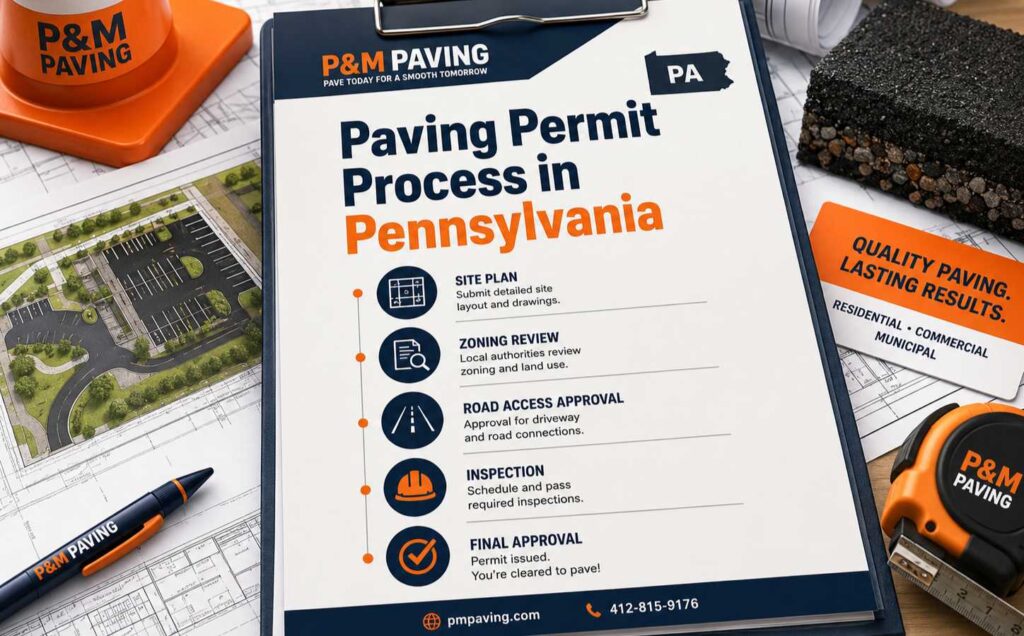
At the same time, paving projects often involve more than one kind of approval. Depending on the scope and location, you may need:
- a local building permit
- a zoning or land use approval
- a right-of-way or curb cut permit
- a PennDOT Highway Occupancy Permit for access to a state road
- stormwater or grading approval if new impervious area is added
- accessibility review for commercial or public-facing projects
State roads and PennDOT permits
One of the most important Pennsylvania-specific issues is whether the driveway or paved access connects to a state-maintained road. PennDOT requires Highway Occupancy Permits for driveways and related access work on state highways, and applications can be submitted through the Electronic Permitting System. PennDOT has also stated that owners should apply at least 30 days before planned work begins, that a residential driveway permit fee is $25, and that failing to obtain a required permit can lead to at least a $100 fine plus court costs. PennDOT also notes that a permit is not normally required for paving an existing and properly permitted driveway, but owners should still contact the permits office before paving because drainage impacts may require corrective work.
Stormwater and drainage concerns
Paving adds impervious surface, and that can change how water moves across a site. Pennsylvania DEP oversees statewide stormwater programs, including municipal, construction, and Act 167 stormwater management programs. In practice, this means many local governments review larger paving projects for runoff, grading, and drainage impacts, especially when driveway expansion, parking lot work, or major resurfacing changes site flow patterns.
Accessibility and ADA requirements
For commercial paving, parking lots, sidewalks, curb ramps, and pedestrian routes, accessibility is a core compliance issue. Federal ADA standards require accessible paths of travel, and the U.S. Access Board states that ramp runs must have a minimum clear width of 36 inches. Pittsburgh code also requires ramps at crosswalks when sidewalks, curbs, or gutters are installed, improved, or repaired at crosswalk locations.
Types of paving work that often need permits in Pennsylvania
Although exact rules vary by municipality, these are the types of projects that commonly trigger permits or review:
- new driveways
- driveway widening or layout changes
- new curb cuts
- driveway aprons connecting to public streets
- sidewalk replacement in the public right-of-way
- patio slabs and concrete pads, depending on height, location, and local rules
- parking lot construction or substantial reconfiguration
- paved parking pads
- grading tied to new asphalt or concrete installation
- commercial ADA upgrades such as curb ramps and accessible parking access routes
Work that may be exempt in some cases
Some paving-related work may be exempt from a building permit, but that does not automatically mean no approval is needed. In Pittsburgh, for example, the city lists sidewalks and driveways that terminate in a garage as work not requiring a permit when they are not more than 30 inches above adjacent grade, not over a basement or story below grade, and not part of an accessible route. However, the same page states that parking pads are regulated and must be permitted through the city’s development review process. Also, separate right-of-way or curb cut approvals may still apply even if a full building permit does not.
That is why owners should never assume that “simple paving” is automatically exempt. The safest approach is to verify with the local municipality and, if applicable, the county or PennDOT.
Pittsburgh permits for driveways, curb cuts, sidewalks, and parking access
For property owners in the City of Pittsburgh, curb cuts and work involving vehicular access are a major part of the approval process. The city states that a Curb Cut Permit must be submitted for all new curb cuts, including curb cuts for driveways, residential garages, parking pads, parking lots, commercial garages, and off-street loading facilities. A permit may also be required for an existing curb cut when no prior permit is on file, when the property use changes, when parking count increases, when the curb cut is widened, when a new garage is proposed, or when the curb cut needs repair or reconstruction.
Pittsburgh also requires review through the Zoning and Development Review process before a curb cut permit application can move forward. The city directs applicants to start this process through OneStopPGH, and it requires submission of an 11 x 17 site plan, photos of existing conditions, and in some cases a right-of-way improvement plan.
Pittsburgh right-of-way rules
City code is clear that no person may construct, reconstruct, repair, cut, alter, or grade any sidewalk, curb, or driveway in the public right-of-way without first obtaining a permit from the Department of Mobility and Infrastructure. The code also states that the work must conform to approved plans and city specifications and is subject to inspection.
Pittsburgh curb cut location and design considerations
Pittsburgh’s curb cut specifications add practical spacing and design rules that affect site planning. The city’s guidance says curb cuts must meet DOMI’s specifications unless an exception is approved. The specifications include clearance rules such as minimum spacing from crosswalks, intersecting streets, and nearby curb cuts. For example, the city’s specifications include a requirement that curb cuts be at least 20 feet from the edge of any crosswalk and at least 6 feet from other curb cuts in standard situations, with larger separations for certain commercial uses.
That means a project can be denied or redesigned even if the owner has enough room on private property, because the location may not work safely within the street environment.
Allegheny County permits for county-owned roads and rights-of-way
If the work is not on a city-owned street but affects an Allegheny County-owned road or right-of-way, county approval may be required. Allegheny County states that typical work within county right-of-way includes driveway and sidewalk installations and repairs, new storm sewer connections, and new road connections. The county also states that construction work is only allowed within county right-of-way once a permit has been issued. Questions about Highway Occupancy Permits related to construction are directed to the county’s Public Works permit office.
This matters for owners and contractors in the greater Pittsburgh market because a project can involve different road authorities depending on exact location:
- city street: Pittsburgh DOMI or local municipality
- county road: Allegheny County Public Works
- state road: PennDOT
Commercial paving permits and compliance in Pennsylvania
Commercial paving typically involves more review than residential projects. A commercial parking lot, loading area, or access drive often triggers building, zoning, circulation, accessibility, and stormwater issues all at once. In Pittsburgh, revenue-generating parking lots also require a Parking Lot License, separate from construction approvals. For access points, curb cuts for commercial garages, parking lots, and loading facilities are explicitly listed within the city’s curb cut permit program.
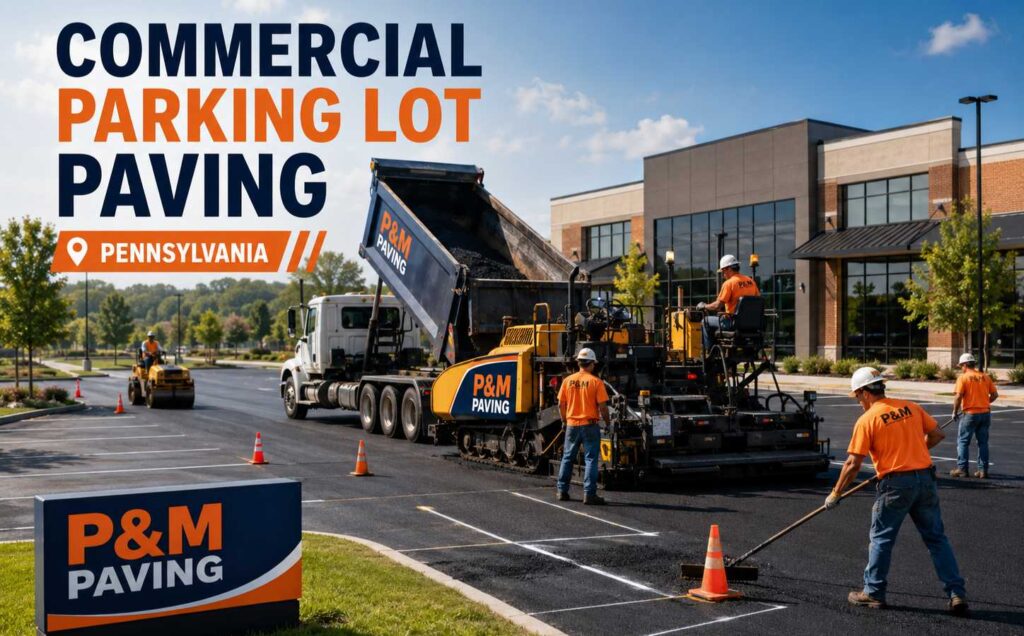
Commercial owners should expect review of:
- traffic flow and ingress or egress layout
- number and spacing of curb cuts
- pedestrian conflicts
- accessible parking routes
- curb ramp conditions
- drainage and runoff
- right-of-way restoration details
- permit closeout inspections
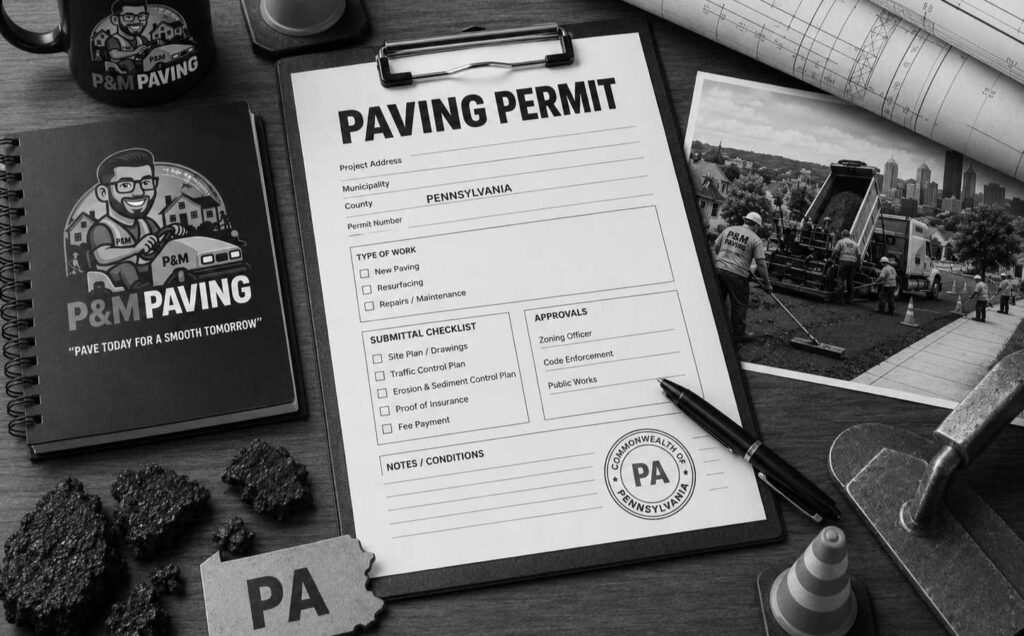
Typical permit application documents
The exact package depends on the municipality, but paving permit applications often require:
- property address and owner information
- contractor information, if applicable
- survey or plot plan
- site plan showing dimensions and setbacks
- photos of existing conditions
- material description such as asphalt, concrete, or pavers
- details on drainage, slope, and ties to existing pavement
- right-of-way plans if public sidewalk, curb, or apron work is included
- zoning approval before permit issuance in some jurisdictions
- proof of road authority approval if the site connects to a county or state road
Inspections and project closeout
Permits are only part of the process. Inspections are what close the loop. Pennsylvania’s UCC framework requires inspections in many cases, and local agencies also inspect right-of-way work. For state road connections, PennDOT’s process includes review and inspection. City code in Pittsburgh likewise states that right-of-way work is subject to inspection.
Typical inspections may include:
- pre-pour or base inspection
- line and grade review
- curb or sidewalk inspection
- final inspection after completion
- restoration check for right-of-way work
Do not leave a permit open after the project is completed. An unclosed permit can create problems later during sale, refinance, insurance review, or future site work.
Pennsylvania permit comparison table
| Aspect | Pennsylvania Statewide | City of Pittsburgh | Allegheny County / Road Authority |
|---|---|---|---|
| Core code framework | Pennsylvania UCC governs code standards and local permit administration. | City applies local zoning, development review, and DOMI right-of-way rules. | County Public Works handles work in county right-of-way. |
| State road access | PennDOT HOP required for driveway access to state roads. | Still applies if the street is state-maintained. | Still applies if the road is state-maintained. |
| New curb cut | Usually local approval required. | Required for all new curb cuts. | County permit may be needed if within county right-of-way. |
| Existing driveway paving | Local rules vary. | May be exempt from building permit in limited situations, but not from all related approvals. | County review depends on right-of-way impact. |
| Public sidewalk / apron work | Often reviewed locally; ADA and right-of-way rules apply. | DOMI permit required in public right-of-way. | Permit required before work in county right-of-way. |
| Key application portal | Local municipality or state system, depending on road authority. | OneStopPGH. | County online permit process. |
| Accessibility | ADA requirements apply to public and commercial routes. | Crosswalk ramp requirements are in city code. | Depends on project type and location, but public work must maintain compliant pedestrian access. |
Tips for homeowners and property managers
Before starting a paving project in Pennsylvania, keep these practical points in mind:
- Check who owns the road first. A local street, county road, and state highway can each trigger a different approval path.
- Do not assume resurfacing is exempt. Even when a new permit is not normally required for an existing permitted driveway on a state road, PennDOT still advises owners to contact the permits office because drainage issues can create liability and repair costs.
- If you are in Pittsburgh, check curb cut status early. Existing unpermitted curb cuts can create problems when properties are improved or sold. The city may require application, correction, or restoration to current standards.
- Expect more review for commercial work. Parking lots, loading areas, and public-facing projects usually involve accessibility and circulation review in addition to basic paving.
- Think about stormwater before you pave. Larger expansions of impervious area can trigger local drainage review.
- Keep all documents. Approved plans, permits, and final inspection records matter later.
Final thoughts
Paving permits and regulations in Pennsylvania can look complicated at first, but the process makes more sense when you break it down by project type and road authority. At the statewide level, the Pennsylvania UCC provides the regulatory framework. At the local level, municipalities handle building, zoning, and development review. If your project touches a public road, sidewalk, curb, or apron, then city, county, or PennDOT approvals may also come into play. In Pittsburgh, curb cuts and public right-of-way work are a major part of the review process, while county-owned roads in the greater Allegheny market have their own permit path.
For homeowners, that means checking permit requirements before replacing or widening a driveway. For commercial owners, it means planning for accessibility, drainage, and traffic access from the start. Taking care of permits early helps prevent redesigns, stop-work issues, drainage conflicts, and problems with final approval.
If you are planning a residential or commercial paving project in the Pittsburgh area, P&M Paving can help you understand the site conditions, scope of work, and likely permit path before construction begins.